From 2 stations in 2020 to 9 in 2025, with 60+ operators approved and Africa’s second-largest mother station now open — Tanzania’s CNG revolution is no longer a pilot programme. This is where it stands, where it is going, and why it matters to every driver in Dar es Salaam right now.
Five years. A completely different picture.
In 2020, there were exactly two CNG filling stations in Tanzania. Both were in Dar es Salaam — one at Tazara, one at Ubungo. Together they served a small community of early-adopter drivers, most of whom had heard about CNG from a colleague and made the conversion out of desperation after petrol prices began climbing.
The queues at those two stations became infamous. Drivers reported waiting hours for a fill-up. The infrastructure simply could not keep pace with even the modest early demand.
Fast forward to 2025, and the picture has changed so dramatically it is difficult to overstate.
As of April 2025, a total of nine CNG stations are operational, up from just two in 2020. The government plans to build six more by 2026, and over 60 private companies have also expressed interest in constructing CNG stations. Thechanzo
Nine stations. Sixty-plus operators approved. A national mother station that can serve over 1,200 vehicles per day. CNG-powered buses running on Dar es Salaam’s BRT routes. This is not a fuel alternative sitting quietly on the margins. This is infrastructure investment at a scale that signals a permanent shift in Tanzania’s transport energy strategy.
The mother station: What it means in practice
Tanzania has launched a state-of-the-art CNG mother station — Africa’s second-largest — located along the Dar es Salaam Rapid Transit corridor. With a daily production capacity of 4.2 million cubic metres of gas, the TSh 18.9 billion investment can refuel up to 1,200 vehicles a day, servicing eight vehicles at once. The Citizen
To understand why this matters, it helps to understand how CNG distribution works. A mother station is not just a large filling station — it is the production and pressurisation hub from which gas is distributed to satellite stations across the city. The larger and more capable the mother station, the more capacity the entire network has.
Deputy Minister for Energy Judith Kapinga, speaking at the launch ceremony in May 2025, said the facility offers a lasting solution to long queues at filling stations. The Citizen The queues that frustrated CNG’s early adopters were a symptom of a single bottleneck — now that bottleneck has been replaced by the second-largest CNG production facility on the African continent.
The vehicle numbers: A movement, not an experiment
The growth in vehicles converting to CNG tells the same story from the demand side.
CNG-powered vehicles in Tanzania grew from just over 1,100 in 2021/22 to more than 7,000 by mid-2024, with some industry estimates projecting the number to have surpassed 15,000 vehicles by 2025. Thechanzo
That is a 13-fold increase in roughly three years. And it is not being driven by government mandates or marketing campaigns. It is being driven by word of mouth between drivers who have made the switch and seen their daily fuel costs cut in half.
By June 2024, more than 1,900 CNG vehicles were refuelling daily in Dar es Salaam — and the number is growing. Africa.com
When 1,900 vehicles per day are fuelling at a network of nine stations — with a new mother station capable of serving 1,200 vehicles per day alone — the infrastructure constraint that defined CNG’s early years in Tanzania has been fundamentally resolved.
Government commitment: The policy signals
The physical infrastructure tells part of the story. Government policy tells the rest.
In the 2023/24 budget, the government introduced incentives to stimulate CNG demand, including a 25 percent customs duty exemption for imported CNG vehicle engines to reduce conversion costs. The Citizen This is a significant intervention — conversion cost is the primary hesitation factor for drivers considering the switch, and a 25 percent reduction in engine import duties directly lowers the price of conversion kits.
TPDC has also partnered with the Dar es Salaam Institute of Technology to establish vehicle conversion workshops in Dodoma and Arusha The Citizen — signalling that the government’s CNG strategy is explicitly designed to extend beyond Dar es Salaam as infrastructure scales.
Tanzania has also unveiled CNG-powered buses for the BRT system, with a prototype bus being the first of 100 gas-powered buses planned to operate on Dar es Salaam’s routes. The Citizen When the city’s mass transit system runs on CNG, the fuel’s status as Tanzania’s primary clean transport solution is effectively formalised.
The regulatory dimension is equally clear. The Tanzania Petroleum Development Corporation’s board confirmed that five mobile CNG stations are being procured for Dodoma, Morogoro, and Dar es Salaam The Citizen — mobile units that can extend CNG access to areas not yet served by fixed infrastructure.
This is comprehensive, multi-layer investment. Physical stations. Production capacity. Mobile units. Duty exemptions. Training centres. BRT integration. It is not the profile of a government experimenting with CNG. It is the profile of a government that has decided CNG is a cornerstone of national transport policy.
Why Mbezi matters in this expansion picture
The geographic distribution of CNG infrastructure in Dar es Salaam has historically followed the city’s existing energy corridors — Ubungo, Tazara, Sam Nujoma Road, the airport area. These are important locations, but they serve a specific portion of the city.
TPDC’s plans for expanded station locations include Mbezi Beach alongside Muhimbili, Kibaha, Sinza, Mwenge, Goba, Mbagala, and the University of Dar es Salaam. Ippmedia The western and northern residential corridors — where large numbers of Bolt drivers, bajaji operators, and commercial vehicle operators actually live and begin their working days — have been underserved by the existing station network.
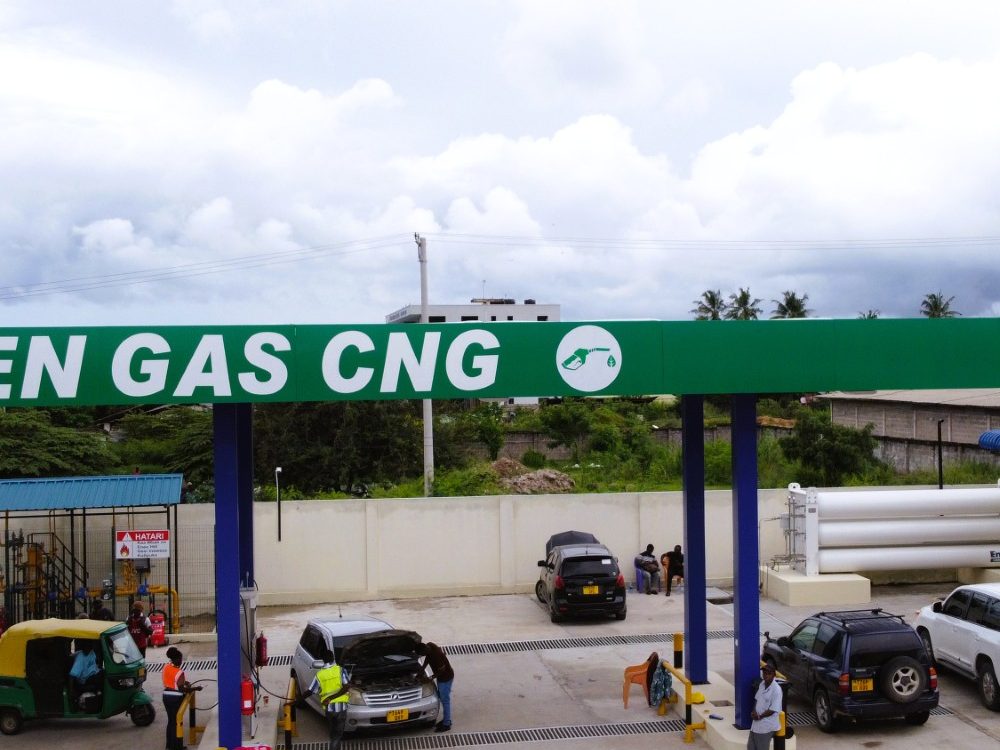
Green Gas CNG in Mbezi addresses this gap directly. For drivers operating the Mbezi–Kimara–Kibamba–Tegeta corridor, we are not just a CNG option — we are the closest and most accessible one. And because we are privately operated with a strong service focus, we deliver what the early TPDC stations sometimes could not: fast dispensing, no queues, and consistent 24-hour availability.
What the expansion means for your switching decision
If you have been waiting to convert your vehicle to CNG until the infrastructure was reliable enough, the infrastructure question has been answered.
Nine operational stations. Africa’s second-largest mother station. 60-plus private operators approved. Government duty exemptions on conversion equipment. Mobile stations being procured for broader deployment. CNG buses on the BRT system.
According to TPDC, CNG-powered vehicles in the country grew from just over 1,100 in 2021/22 to more than 7,000 by mid-2024, with some industry estimates projecting the number to have surpassed 15,000 by 2025. Independent magazine These drivers did not wait for perfect infrastructure before converting. They saw enough — a reliable station on their route, real savings reported by colleagues, a conversion payback measured in months rather than years — and they acted.
The infrastructure has now gone significantly beyond “enough.” It is robust, growing, government-backed, and expanding into every major district of Dar es Salaam.
The cost of waiting — a real calculation
Here is the practical implication of infrastructure expansion for a driver still on the fence.
Every month you continue driving on petrol in Dar es Salaam, you spend approximately 832,000 shillings on fuel. Every month you drive on CNG at Green Gas costs approximately 364,000 shillings. The difference — 468,000 shillings — is the monthly cost of waiting.
Over six months, that is 2,808,000 shillings in avoidable fuel costs. Over a year, it is 5,616,000 shillings — enough to buy a conversion kit, cover a year’s worth of inspection fees, and still have significant money remaining.
Although converting a vehicle can cost as much as 1 million shillings, many drivers recover this investment within months through fuel savings. Private garages in Dar es Salaam have responded by offering instalment plans to make conversions more accessible. Africa.com
The instalment plan point is worth emphasising. You do not need 1,000,000 shillings in cash today to access the savings. You need to find a certified garage offering a payment plan — and Green Gas CNG can refer you to partners who do.
Tanzania’s position in the regional CNG story
Tanzania’s CNG expansion is happening in a regional context that adds further momentum and legitimacy.
Egypt’s CNG programme had reduced carbon dioxide emissions by around 5 million metric tonnes by 2021 and converted more than 500,000 vehicles by 2023. Kenya is also piloting CNG buses and ride-hailing fleets, part of a wider push for cleaner and more affordable transport across Africa. Africa.com
Egypt’s programme — which Tanzania explicitly looks to as a model — took decades to reach scale, driven by government subsidy and consistent policy commitment. Tanzania is compressing that timeline dramatically, with nine operational stations already in place and 60-plus operators actively building more.
A government urban transport analyst, Fatma Mshindo, said: “If scaled properly, CNG can bridge the gap toward sustainable transport while improving air quality now.” Africa.com
The scaling is happening. It is happening in Dar es Salaam, with real investment and real infrastructure. And it is creating a window for drivers to lock in fuel savings before petrol prices — which are determined by factors entirely outside Tanzania’s control — inevitably rise again.
The moment to act is now, not later
Tanzania’s CNG infrastructure is no longer fragile, no longer experimental, and no longer concentrated at two stations serving the whole city. It is a mature, expanding network backed by national policy, private investment, and the lived experience of 15,000 drivers who have already made the switch.
Juma, a 32-year-old bajaji driver from Dar es Salaam’s Temeke district, described the change after switching to CNG: “When I was using petrol, I used to stop working before sunset. Fuel was too expensive. With gas, I work longer and keep more money after every trip.” Independent magazine
This is the CNG story in Tanzania — told by the people living it. Not by government press releases or industry reports, but by drivers who made a practical financial decision and found that it changed the economics of their entire working day.
Green Gas CNG in Mbezi is open right now. Come in, fill up, and become part of the movement that is already reshaping how Dar es Salaam drives.